Automatically generated narration. Code examples are available in the article.
Letting businesses build their own agent
I worked on a platform where restaurants, shops, and other businesses can create a chat agent from their own information. Users create an agent in a web interface, then upload FAQs, manuals, business documents, or website content.
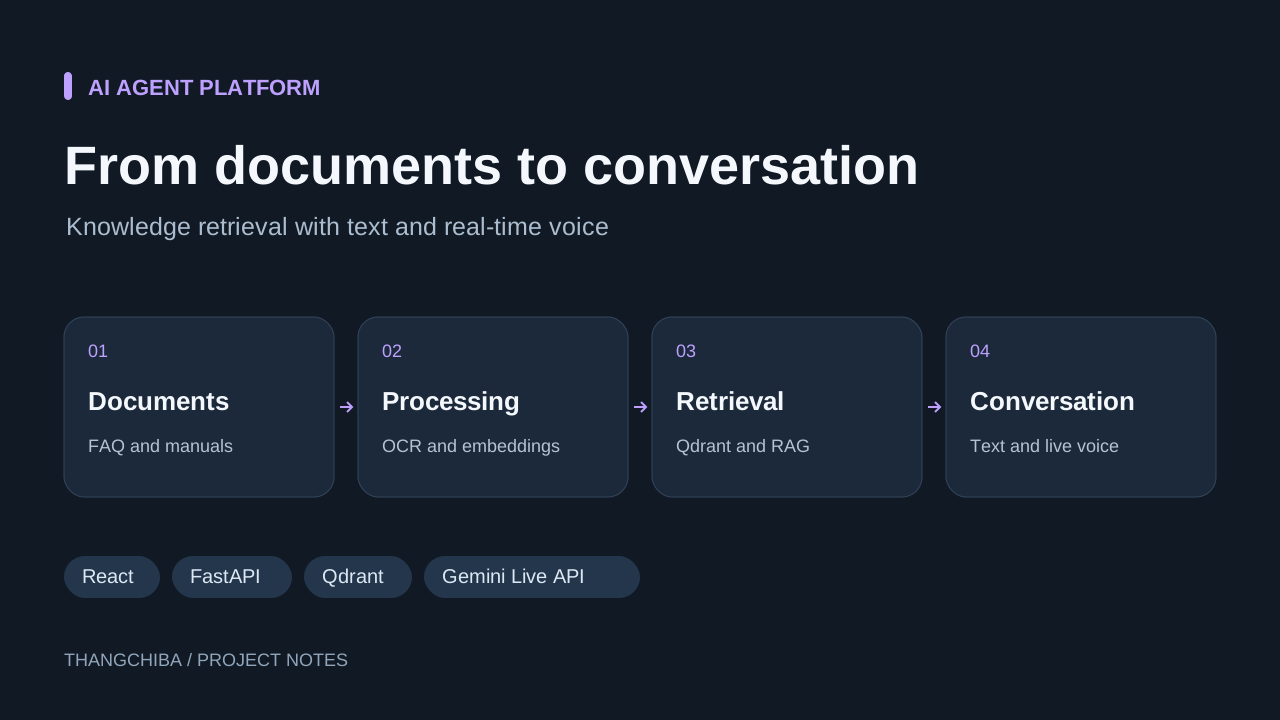
The document pipeline extracts text, uses OCR where needed, splits the content into chunks, creates embeddings, and stores vectors in Qdrant. During a conversation, the backend retrieves relevant content and passes it to an LLM to generate an answer.
My role as Team Lead
I led the five-person team through the initial architecture, technology selection, and MVP implementation. The first goal was to get the full flow working: create an agent, upload a document, create embeddings, retrieve knowledge, and answer a question.
I built the base React screens and FastAPI endpoints for agent management, users, documents, chat, embeddings, and vector search. MongoDB stores settings, user and file information, chat history, and knowledge-management metadata.
Once the MVP was working, I divided the remaining tasks, documented implementation rules, reviewed code, investigated technical issues, and tracked progress with the team.
Model selection and voice
The architecture allows different model settings per agent, using local LLMs or OpenAI and Gemini APIs according to the use case. I also evaluated RAGFlow while exploring the document workflow.
I implemented real-time voice conversations with Gemini Live API, giving users a way to ask questions by speaking as well as typing.
Deployment and lessons
The FastAPI backend runs on EC2. The frontend is hosted in S3 and served through CloudFront, with Route 53 for the domain.
The project taught me that RAG quality depends on the full document pipeline, not just the LLM. OCR, chunking, embeddings, and retrieval all need attention. For voice, response time and conversational UX matter alongside answer quality.
Role: Team Lead · Team: 5 · Period: April–July 2025.